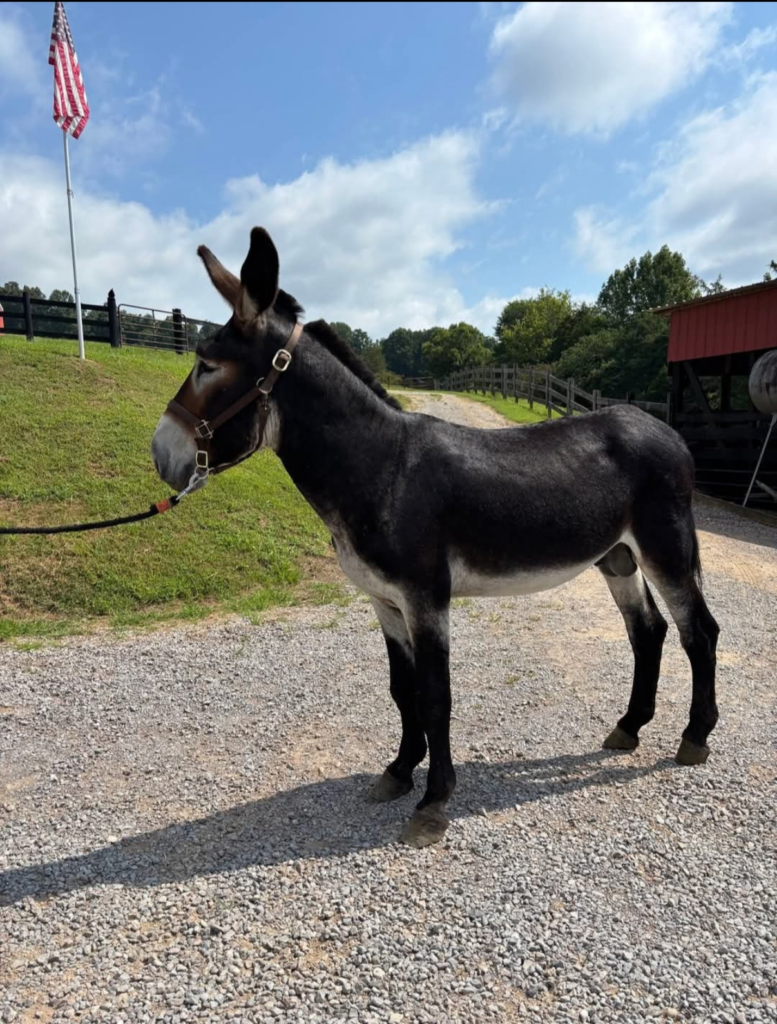
Mammoth Jacks: A Southern Legacy With Modern Purpose
Overview
The American Mammoth Jackstock—the largest of the donkey breeds—helped power American agriculture for more than a century by producing the mules that plowed fields, hauled timber, carried mail, and supplied armies. From George Washington’s early breeding program to today’s heritage-breed stewards, Mammoth jacks have been engines of practical progress whose value is rising again as landowners rethink resilience, cost, and stewardship.
At Woodland Plantation, we’re investing in Mammoth jacks crossed to our draft mares to produce working mules for farming, hunting logistics, and search-and-rescue. This is not nostalgia—it’s a strategic choice grounded in history, biology, and sound farm economics.
How America Got Its Mammoth Jacks
America’s mule era began in earnest when George Washington imported superior European jacks to improve domestic stock. In 1785 King Charles III of Spain sent Washington the famed jack Royal Gift, and in 1786 the Marquis de Lafayette arranged for a Maltese jack often remembered as the Knight of Malta. Washington immediately prioritized mule production at Mount Vernon because he found mules worked longer on less feed and held up better than horses in heavy farm tasks. These importations and subsequent breeding efforts laid the genetic and cultural foundation for America’s large working mules and later the formal development of the American Mammoth Jackstock.
By the late 19th and early 20th centuries the Mammoth Jackstock had registries (consolidated in 1923) and a national footprint; U.S. mule numbers peaked around 1920, reflecting how central these animals were to farm and freight power.
Why Mammoth Jacks? Biology and “Hybrid Vigor”
Crossing a Mammoth jack with a draft mare produces a mule with traits that matter on real work: sure-footedness, hard hooves, disease resistance, long service life, and exceptional endurance—the classic benefits of hybrid vigor. These aren’t myths; they’re well-documented working advantages that made mules the preferred draft and pack animal across difficult terrain from the American West to mountain supply lines.
Historic and Contemporary Uses of Mule Power
- Row-crop & farm work: Plowing, cultivating, and hauling on mixed soils where traction and low compaction are crucial.
- Timber & field hauling: Skidding logs with minimal soil disturbance and access into wet or wooded ground where tractors bog or can’t maneuver. (Historical practice; widely documented in draft-animal literature.)
- Pack & patrol: From Grand Canyon supply trains to backcountry freight, mules remain the gold standard where footing is unforgiving.
- Emergency & SAR: Their stamina, calm temperament, and stability on broken ground are compelling for mounted search-and-rescue and medical evacuation in places vehicles cannot go. (Modern working programs build on the same traits noted above.)
Woodland Plantation’s Breeding Focus
We plan to stand Mammoth jacks over selected draft mares to produce a versatile string of plantation mules tailored to our landscape and mission:
- Farm Power: Cultivation, produce hauling, compost handling, and field transport with minimal fuel inputs and lower soil compaction than heavy equipment.
- Hunting & Land Stewardship: Quiet, reliable pack animals for game retrieval, feed/salt drops, and trail maintenance in wet, sandy, or forested ground.
- Search & Rescue: Sure-footed mounts for grid searches, gear hauling, and patient transport where ATVs and trucks can’t safely travel.
This program also helps conserve a heritage breed whose numbers declined sharply in the mid-20th century and is now being actively preserved for genetic diversity and working utility.
Are Mules “More Efficient” Than Tractors? It Depends—Here’s the Practical Math
Tractors revolutionized agriculture, but animal traction never stopped making sense in certain contexts. Global agricultural analyses (including FAO) emphasize fit-for-purpose decisions: farm size, terrain, capital costs, fuel/parts access, and utilization rates all drive whether animals or engines are more economical. For small to mid-scale, diversified, or wet/wooded operations, draft power can be financially and operationally superior.
Where Mammoth-jack mules shine vs. tractors:
- Capital & Risk: Lower upfront costs and no exposure to fuel price shocks; maintenance is labor and forage rather than diesel and specialized parts.
- Terrain & Soil: Better mobility in woods, bottoms, and soft ground; dramatically less soil compaction than heavy axles—preserving soil structure and drainage. (FAO notes appropriateness of animal traction where soils and access limit engine efficiency.)
- Utilization: On diversified farms, animals can work fields, pack timber or game, and serve SAR/community roles year-round—high utility even at small scales.
- Environmental Footprint: Comparative life-cycle studies show scenarios where animal traction carries lower environmental burdens than machine traction; outcomes vary by system, but the point stands: the greener option is often the one that fits the place.
Where tractors still win: Heavy primary tillage on large acreages and time-sensitive field windows where peak horsepower per hour is decisive. The smart 21st-century approach is complementarity, not ideology.
Conservation With a Job to Do
Breeding Mammoth jacks for work at Woodland Plantation supports a living conservation model: animals that earn their keep while preserving rare genetics. That was Washington’s original insight—breed better jacks, get better mules, and let practical performance pay for the program. It worked for the early Republic, and on a diversified Southern property it still works today.
Closing
Mammoth jacks and the mules they sire are not relics. They are adaptable, economical, and environmentally sensible partners for farms, forests, and search-and-rescue teams. At Woodland Plantation we’re proud to help write the next chapter of this American story—one strong, sure-footed mule at a time.